
As part of an ongoing exploration of Polyvagal Theory and the Gyrotonic Method, we’re pleased to share the third and final article in this thoughtful series by Master Trainers Rita Renha, PT and Kate Pagliasotti, MS LAc. Their work offers a meaningful perspective on how nervous system awareness can deepen the relational and experiential aspects of teaching.
In the first two posts, they introduced key elements of Polyvagal Theory and reflected on how this lens can shift the feeling tone within the body and the learning environment. If you haven’t read them yet, we encourage you to start with Part 1, which introduces the foundational principles, and Part 2, which explores how these ideas began to shape their experience in the training space.
We’re grateful to Rita and Kate for allowing us to share their insights with the broader Gyrotonic community. In this final installment, they turn toward the practical application of these ideas within a one-on-one session—exploring how principles such as neuroception, co-regulation, and hierarchy can inform the unfolding dialogue between teacher, client, and the equipment.
The Hierarchy at Work: How to Structure a One-on-One GYROTONIC® Session Using Regulation, the Equipment, and Relational Touch
By Rita Renha, PT and Kate Pagliasotti, MS LAc
When we put together our presentation for the Gyrotonic Rehabilitation Conference in Washington, DC in 2025, we called it “Between Self, Other, World and System.” We chose this title to name what is always present – and often unnamed – in our work: the relational field. This field is co-created by teacher, client and environment. It is informed by the intelligence of the Gyrotonic Method and the specific dialogue created by the equipment. It is not abstract, but tangibly felt. It changes moment to moment, and it is within this alive space that regulation, learning, healing and change
become possible.
In Part 1 of this series, we introduced key elements of Polyvagal Theory and how they can support us in teaching not just from the repertoire, but from embodied awareness. In Part 2, we shared how this lens helped us shift the feeling tone in our own bodies and in the training environment to support deeper understanding and connection. In this final post we go deeper into the three Polyvagal principles that directly inform how a one-on-one session unfolds in real time: Neuroception, Co-Regulation and Hierarchy.
Within Polyvagal Theory, the concept of hierarchy describes how the nervous system organizes experience through three primary states — dorsal vagal shutdown (immobilization), sympathetic mobilization (fight/flight), and ventral vagal regulation (social engagement and connection). These are not psychological labels, but physiological patterns that influence posture, breath, muscle tone, perception, and capacity for learning. This way of understanding the nervous system response can become a practical compass – not just as a theory to remember but as a map we can follow so our sessions become more alive, more effective and more human.
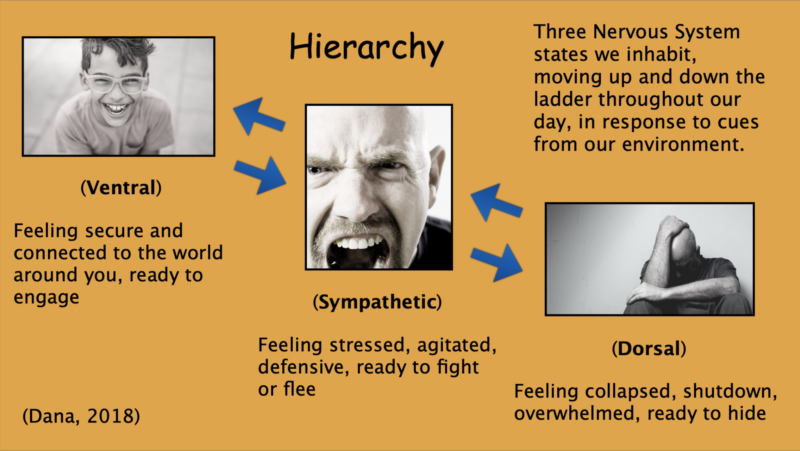
A simple map of the nervous system hierarchy guiding how we meet and teach the body.
1. Receiving the Client Through the Hierarchy (Applied Session Compass)
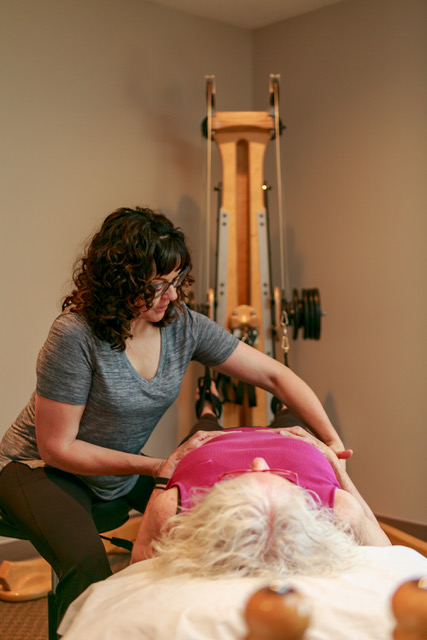
Meeting the client through presence and listening touch, before inviting movement.
Before any instruction, before any movement, before the equipment, every session begins with a state. The first meeting is not cognitive, it is not technical, it is nervous system to nervous system. Whether we are aware of it or not, there’s a silent conversation unfolding inside our client: Is it safe enough for me to be here? Is this a place where I can feel, explore, and reorganize, or do I need to protect myself?
This is Neuroception – the nervous system’s constant subconscious detection of safety or threat. And it is where our work truly begins. When we teach through a Polyvagal lens, our task is to attune to where on the hierarchical ladder our client is residing as they arrive for a session. We meet what is present, without imposing a state upon them, and we structure the session so the client can move towards regulation through safety, rhythm, breath and support.
If a client arrives in dorsal stillness or collapse (bottom of the ladder):
• Flat tone, low energy, heaviness, disconnection, minimal expression
Our primary goal is to invite gentle mobilization without demand and create a sense
of safety and connection. Before we ask the body “to do,” we ask it to feel.
How you teach:
• Soften your voice and reduce verbal information
• Slow, gentle pacing with supported pauses (no empty silence to keep the energy from collapsing further)
• Avoid performance, complexity and intensity
Where to start:
• Grounding – Sensing contact with the floor or equipment
• Selections from the GYROKINESIS® series, Awakening of the Senses, using vibration and percussion on the body as a safe stimulus
• Wake up the edges of the body to re-orient and engage (awaken hands and feet/Chew the floor)
• Pendulum rocking, front and back, side to side, figure 8’s, using the breath
• Begin at a rhythm that matches the client, and gradually increase pace as you progress
Signs you can progress (invite faster pacing, fuller range of motion, more complexity, engage with equipment)
• Breath becomes deeper and more rhythmic
• Eyes are engaged and present, face begins to “warm”
• Body begins to “want” movement
Can begin to add Biopump with rhythm, 4 X 4 series (spinal motions – Arch and Curl,
Spiral, Side Arch and Wave in sets of 4) or move to equipment
Hierarchy Principle: From shutdown to mobilization, led by safety, not technique
If a client arrives in a Sympathetic State
• Urgent, effortful, irritable, driven, tight jaw/ribs/neck
Our primary goal is to downshift activation in the nervous system through rhythm and predictability.
How you teach:
• Reduce cognitive demands
• Make your voice warm and face open
• Begin with more rhythmic pacing to meet them where they are, slowly decrease intensity as regulation increases
• Choose simple sequences with repetition and breath
• Avoid corrective, aggressive touch or too much variety too soon
Where to start:
• Seated work on the stool or tower with familiar patterns
• Use rocking motions/figure 8’s/biopump with pace
• 4 X 4 from spinal motions with pace and rhythm, gradually inviting slower pacing
• Small range Pulsations on handle unit, sagittal and with spiral
• Or begin standing, stepping into the floor to discharge energy through the
feet. Use gentle stamping and let the vibration release into the floor
• Continue with weight shifts and a step-close pattern circling around the
body, beginning with four counts and slowing into eight
Signs you can progress (invite slower pacing, modulated rhythm, larger range of motion, yawning quality to movement, longer exhalations, touch):
• Breath begins to lengthen
• Shoulders drop
• Face gets softer
• Movement naturally begins to suspend
Hierarchy Principle: From mobilization to regulation via pacing, rhythm and connection
If a client arrives in Ventral Vagal (top of the ladder of Hierarchy)
• Present, curious, playful, grounded, responsive, warm and open face
Primary goal is to use complexity to deepen learning, not to “regulate”
How you teach:
• Support mindful awareness, help the person “arrive”, observe their breath
• Use session to support clients long-term goals
• Encourage participation, choice and agency in choosing material
• Emphasize three-dimensional co-ordination
• Larger range of motion, more variety, more dynamic movement
• More precise cuing and more intentional, guiding touch
Hierarchy Principle: Safety allows for complexity; regulation allows integration
What this changes in our teaching (The Hierarchy becomes the structure of the session):
• Dorsal: support + simplicity → awaken safety
• Sympathetic: rhythm + predictability → downshift effort
• Ventral: complexity + play → integrate and expand
Instead of asking “What should we teach today?,” we ask “What does this nervous system need first in order to receive teaching?”
2. Communication Through the Equipment (The equipment as co-regulator)
Once safety and connection are established between teacher and client, the Gyrotonic equipment becomes more than a tool—it becomes part of the relational field. The resistance, rhythm and structure the equipment provides communicates directly with the nervous system, guiding the client from awareness of their environment (exteroception) to sensing their inner world (interoception).
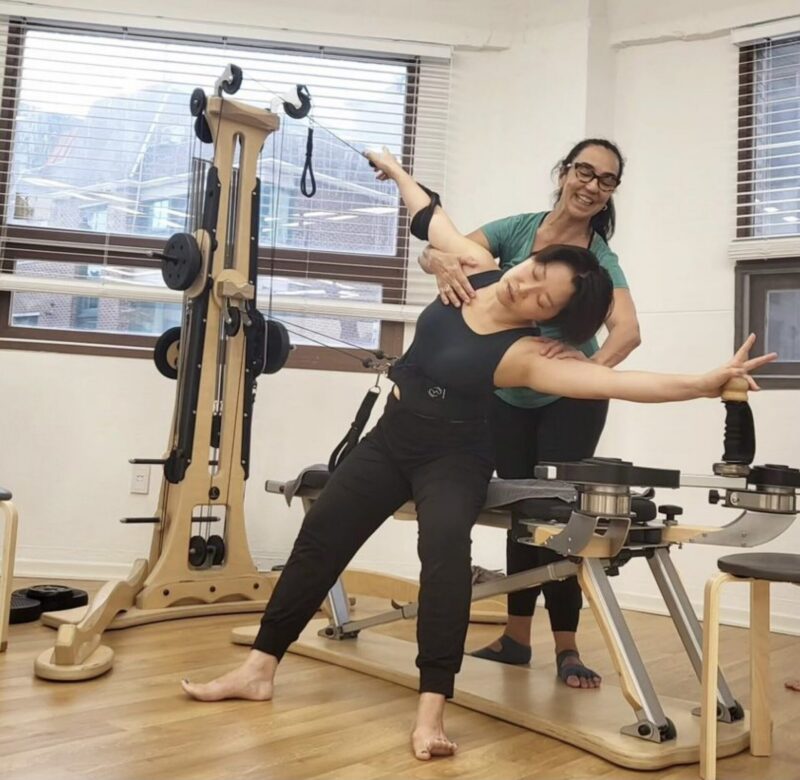
The equipment as a co-regulator—movement emerges through feedback, not force.
Through the handles and straps, the hands receive clear information about where they are and how to organize in space. The spiraling, three-dimensional patterns invite the whole body to move as a unit, improving coordination, balance, and spatial
awareness. The continuous rhythm of the sequences—especially when breath and movement sync—helps the nervous system to settle and organize. The client can gradually release unnecessary effort and protective holding, and move more efficiently. Instead of lifting against gravity, the body learns to respond to it, finding an organized length from the center outward. Learning happens naturally as the body becomes more available. This is co-regulation happening in real time. The client enters a loop of feedback where the body senses:
• I am supported
• I can lean into something and it holds me
• I can move and still feel safe
3. The Touch that Moves You (Touch as education)
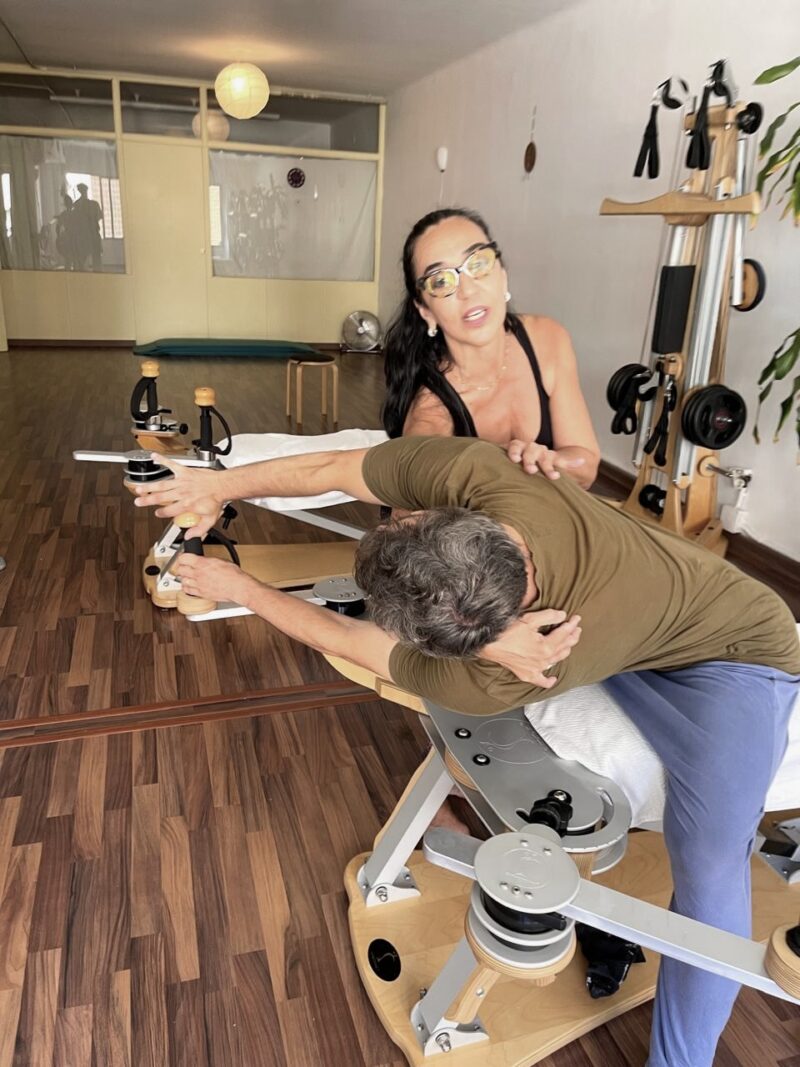
Touch as education—offering the body a felt pathway to organize from within.
The touch that moves you begins by listening. Before guiding, the teacher’s hands sense the tone and organization of the tissues — a kind of touch that gathers information rather than trying to change anything. This first contact offers the nervous system a signal of safety and connection.
From there, the hands accompany movement, guiding the body into a new experience of organization in space. Movement is not done to the person, but with their structure — creating direction, support, and suspension so the body can sense how it relates to gravity. The purpose of this hands-on work is to offer a sensory stimulus the person can then reproduce on their own. The body learns the feeling; the brain remembers the pathway.
For example, in the Foundation Course, one of the hands-on explorations introduces the spiraling quality of the arm. When the humeral head is gently guided to rotate in its socket, exploring the spiraling quality of the arm, the person begins to feel how this spiral organizes the entire arm — from the center through the elbow, into the palm and fingers. From this new sensation, awareness emerges and a new pathway
becomes available. The principles of the method are no longer ideas — they become embodied. Touch becomes a form of co-regulation through contact, offering the nervous system a felt sense of orientation and continuity.
Closing
In the Gyrotonic system, movement is never separate from relationship. Every movement is a part of a conversation between systems – Inner and outer, Self and Other, Human and Equipment. To teach through a Polyvagal lens is to understand that this conversation begins in safety, unfolds through regulation and connection, and culminates in awareness. The pulleys, wheels, straps and springs of the equipment respond to tone and rhythm, they can mirror the nervous system and its natural transitions. Through that responsiveness, the body experiences an external world that
meets it, engages with it, and allows the body to come home to itself.
About the Co-Presenters
If you’d like to learn more about Kate Pagliasotti, MS LAc and her practice, visit Inner Court Acupuncture. For more information and contact information for Rita Renha, PT — Master Trainer & Somato-Emotional Physical Therapist, visit Rita Renha Wellness.
Want to read more? Take a look at these other inspiring stories from our community:
Polyvagal Theory: Exploring the Nervous System’s Role in Movement & Connection (Part 1)
Embodied Application: Teaching Though a Polyvagal Lens (Part 2)
The Power of Connection: Bringing Nonviolent Communication (NVC) to the GYROTONIC® Community