We are excited to share an insightful reflection from GYROTONIC® Trainer and trauma-informed Acupuncturist Kate Pagliasotti, co-presented with Master Trainer and Somato-Emotional Physical Therapist, Rita Renha. Their recent talk at the Gyrotonic Rehabilitation Conference explores how Polyvagal Theory can deepen our understanding of the GYROTONIC EXPANSION SYSTEM®, revealing how presence, safety, and attunement shape every movement and learning experience.
Read on as Kate shares highlights from their presentation and reflects on how nervous system awareness can transform the way we teach, move, and connect.
Between Self, Other, World, and System: A Polyvagal Perspective on the GYROTONIC EXPANSION SYSTEM®
By Kate Pagliasotti, MS LAc
In April 2025, Rita Renha and I had the good fortune to present together at the Gyrotonic Rehabilitation Conference, hosted by Justine Bernard and Elements Center in Washington, DC. Our presentation emerged from our shared curiosity about how Polyvagal Theory can deepen and refine our understanding of the work we do as Trainers, movers, and teachers.
Though Rita and I arrived at this intersection from different paths—Rita as a Master Trainer and Physical Therapist with a background in Hakomi Therapy, and I as a GYROTONIC® Trainer and trauma-informed Acupuncturist—we share a deep appreciation for how the nervous system shapes every movement, interaction, and learning experience. With our shared dance backgrounds, we both know how easily nervous system needs can be overridden by traditional training methods that prize technique and precision over presence and connection. In today’s fast-paced world, bringing awareness, attunement, and nervous system literacy into our teaching feels more vital than ever.
Feeling Bodies That Think
We opened our presentation with a quote from neuroscientist Jill Bolte Taylor, author of My Stroke of Insight: “Most of us think of ourselves as thinking bodies who feel, but we are actually feeling bodies who think.”
This simple statement beautifully captures what we’ve long experienced: movement is not just physical—it’s relational, emotional, and energetic. Likewise, learning is not purely cognitive—it’s embodied.
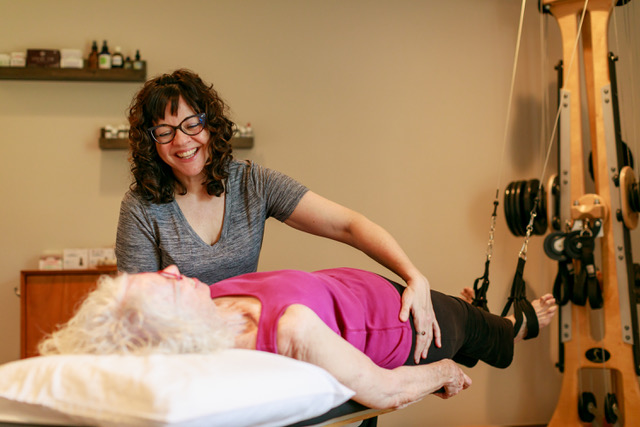
Rita works with a student; image provided by Rita Renha
The GYROTONIC® and GYROKINESIS® Methods are not intellectually engineered; they were born from lived, sensory experience. To teach them with integrity, we must meet students with both knowledge and attunement. Polyvagal Theory helps explain why tone, timing, and touch matter, and why creating a sense of safety isn’t optional—it’s foundational. It sheds light on why some clients can grasp a movement intellectually but struggle to embody it, and why co-regulation between teacher and student is the fertile ground from which transformation grows.
Understanding the Polyvagal System
Introduced by Dr. Stephen Porges in 1994, Polyvagal Theory revolutionized our understanding of the autonomic nervous system and how it evolved over time to meet changing survival need. Early ancient reptiles immobilized in the face of danger; later species evolved to fight-or-flee, and finally as mammals we made an important neural leap: the ability to be safe and still in close proximity to our caregivers in order to nurse and bond.
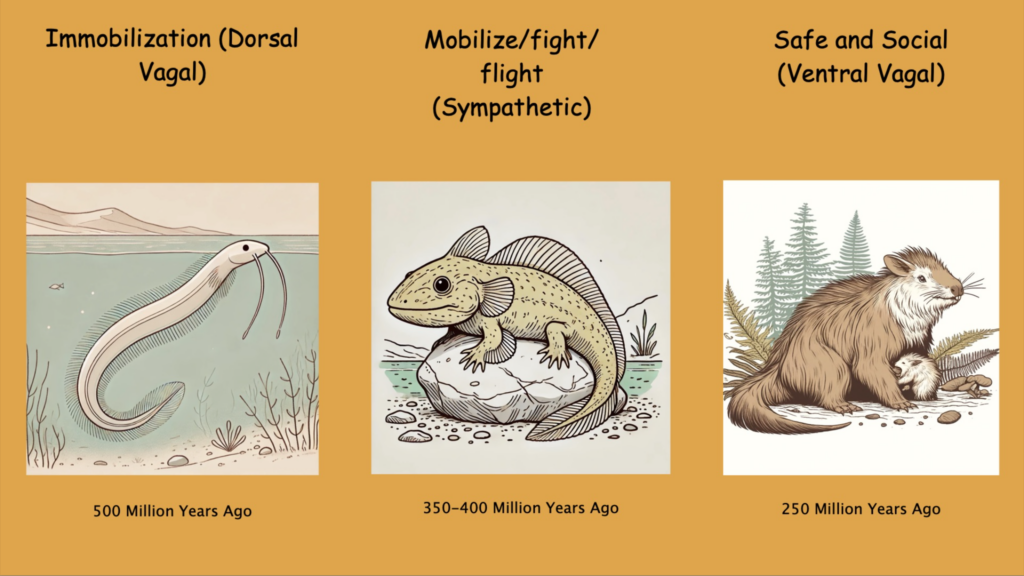
Image provided by Kate Pagliasotti
At its heart, Polyvagal Theory identifies two core human needs: the drive to survive and the desire to connect. To navigate these competing demands, our nervous system relies on a complex communication network, including the Vagus nerve—a bidirectional “neural superhighway” that constantly reads cues of safety and danger, sending information from the body to the brain and back again. Dr. Porges named this subconscious process of detection Neuroception, and it influences how we feel and behave before we’re even aware of it. Depending on the signals we receive from our own bodies, the environment around us and the people we are interacting with, we shift between three primary autonomic states:
- Ventral Vagal — Calm, connected, socially engaged
- Sympathetic — Mobilized for action (fight or flight)
- Dorsal Vagal — Immobilized or shut down (freeze or collapse)
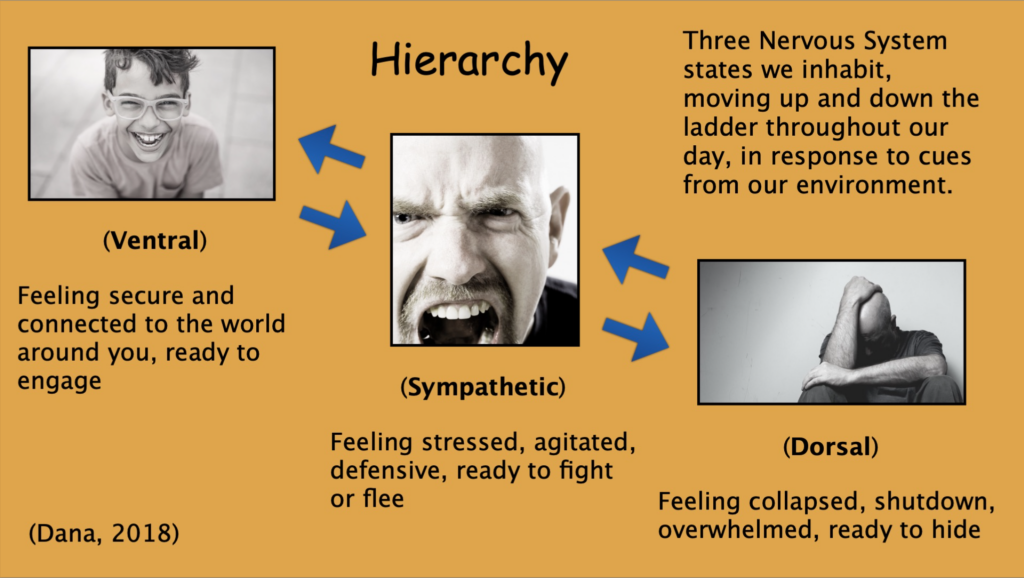
Image provided by Kate Pagliasotti
We can think of these branches of the nervous system as steps on a ladder we move up and down throughout the day. Safety cues move us up toward connection and learning; cues of danger move us down the ladder toward protective responses like freezing or flighting. Dr. Porges called this predictable progression Hierarchy, one of three core principles of PVT, alongside Neuroception and Co-Regulation.
Applying Polyvagal Theory in the Studio
As movement educators, understanding this ladder gives us a practical framework. When we can sense where someone is on their nervous system ladder, we can meet them there. Learning and transformation are only possible when students feel seen and safe. Knowing the language of the nervous system helps us teach in a manner that honors our client’s moment to moment experience.
Creating that safety begins with our own regulation. When we’re attuned to our internal states—our breath, muscle tone, and emotional cues—we naturally become more sensitive to those we teach. This awareness allows us to co-regulate with our clients, providing the stability and presence they need to explore movement more fully.
Take a moment to recall a recent experience when you felt frustrated or unsettled – perhaps after receiving upsetting news or being caught in traffic. Notice what happens in your body: how your breath changes or your shoulders tense or your jaw gets tight. Now recall a time when you felt deeply at ease or more like your best self—feel your shoulders soften, your belly relaxing, your heart feeling more expansive. These subtle shifts are happening throughout our day. By learning to recognize them in ourselves, we become skillful at sensing them in others—and responding with presence rather than reaction.
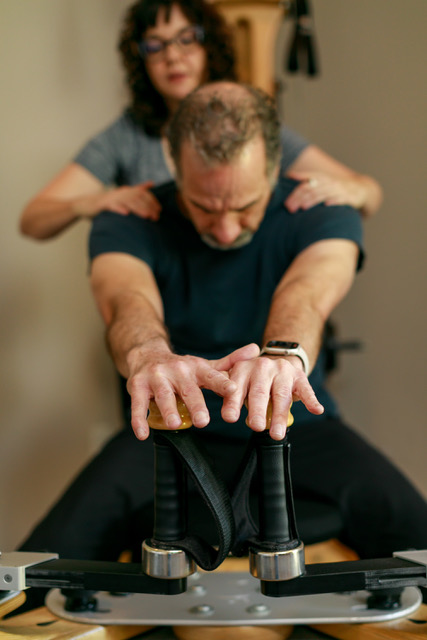
Kate Pagliasotti works with a client. Image provided by Kate Pagliasotti
This is what Juliu Horvath means when he speaks of becoming a witness to your own experience. In GYROTONIC® practice, this witnessing unfolds through a felt connection—with the equipment, the teacher, and the movement itself. Through this process, the body learns from the felt experience of movement, where sensation awakens perception and perception evolves into understanding.
Polyvagal Theory gives us a language to understand this unfolding: it helps us see how attunement to the the body’s internal signals (called Interoception) supports the ability to observe, regulate, and integrate. Cultivating this embodied witnessing allows us to guide others not from correction, but from connection—the essence of transformational teaching.
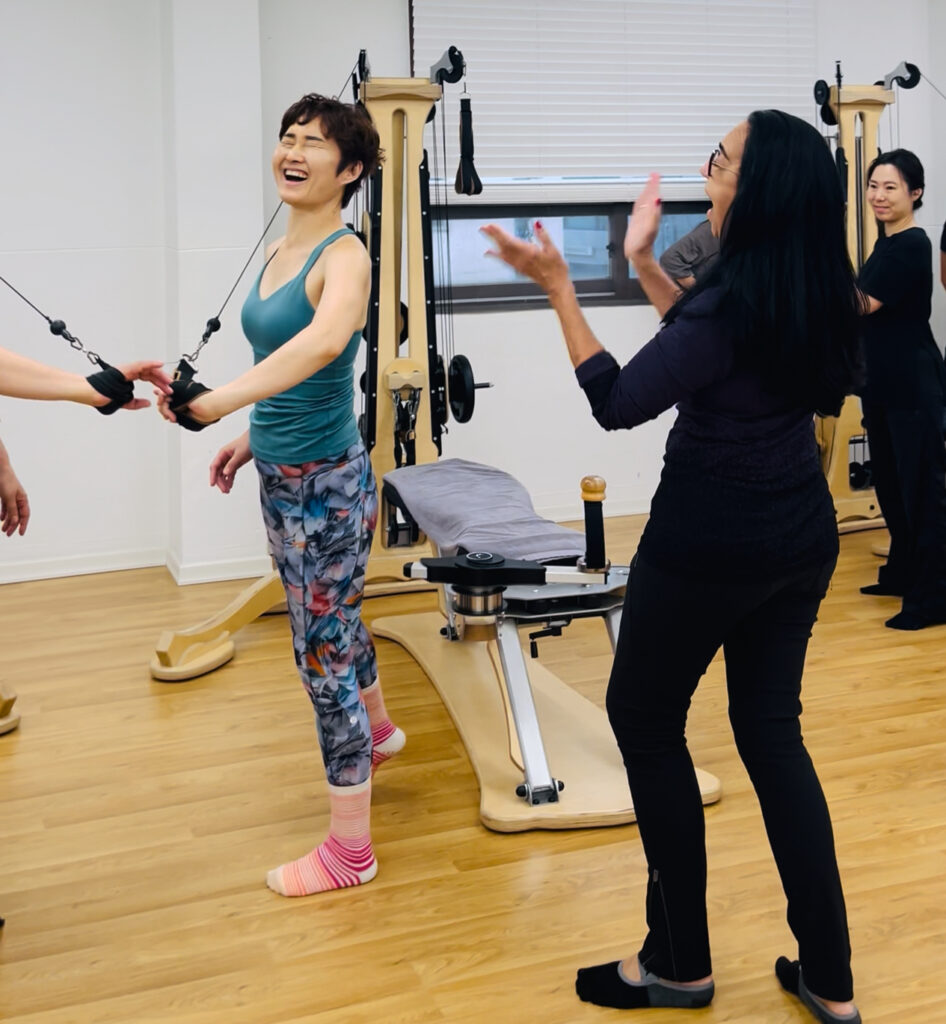
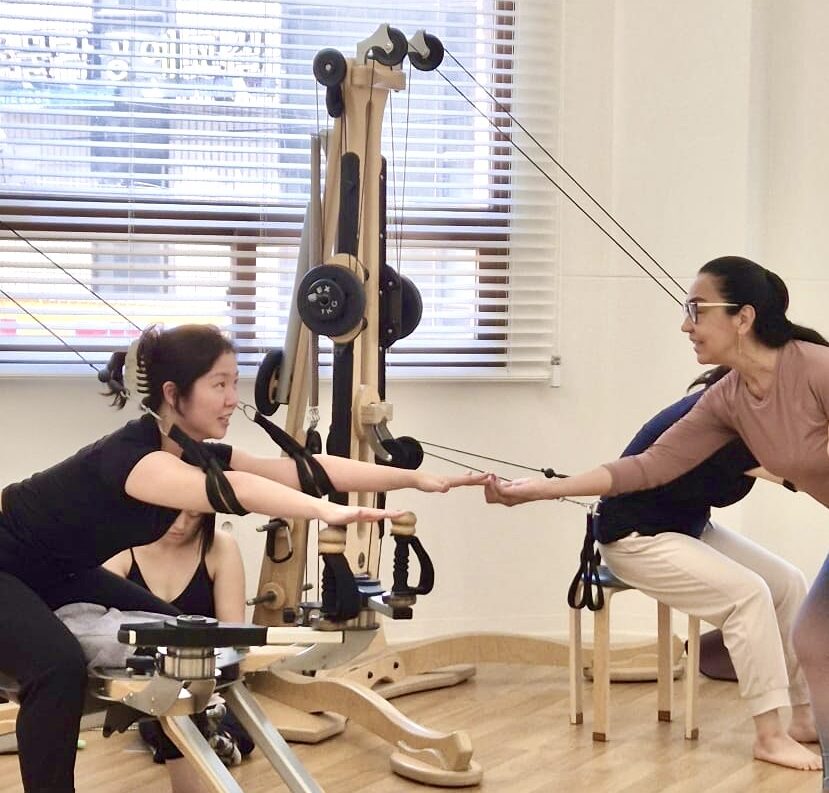
Rita teaching and connecting; image provided by Rita Renha.
A Living Example
In June, I had the opportunity to take a Level 1 Gyrotonic Update with Master Trainer Stephanie Spencer in Aptos, California. At the end of the course, one participant thanked her for creating such a safe, supportive learning environment. Stephanie’s teaching exemplified the principles Rita and I spoke about—she made space for each personality in the room, encouraged us to work thoughtfully with our partners, and invited us to move from feeling rather than intellect.
It was a joy to experience this firsthand: to feel how a teacher’s regulation, presence, and attunement can create an atmosphere where each person can explore with curiosity and confidence. It affirmed how vital this nervous system awareness is—not just in theory, but in practice.
What’s Next?
Stay tuned as we continue to explore how understanding the nervous system can deepen our connection to ourselves, our students, and this extraordinary work we share.
In our next post, we’ll explore practical ways Polyvagal Theory can inform how we structure sessions, lead teacher trainings, and create environments that nurture safety and transformation through the Gyrotonic Expansion System.
About the Co-Presenters
If you’d like to learn more about Kate Pagliasotti, MS LAc and her practice, visit Inner Court Acupuncture. For more information and contact information for Rita Renha, PT — Master Trainer & Somato-Emotional Physical Therapist, visit Rita Renha Wellness.
Want to read more? Take a look at these other inspiring stories from our community:
Welcoming Every Body: Creating Inclusive Spaces in Gyrotonic Studios
Healing from Trauma with Movement – A Personal Experience
Tips for Trainers, By Trainers: Working with Clients Who Have Suffered PTSD
To find Gyrotonic and Gyrokinesis classes near you, visit our Studio Finder tool. To learn more about how to become a Gyrotonic or Gyrokinesis Trainer, visit our Teacher Education page.